
Putting a copper roof on a house in a historic district usually starts with one question: does your town regulate exterior changes, and how strongly? In New Jersey, each municipality decides how much power its historic preservation commission has, so the same copper bay roof can need a binding approval in one town and only advice in another. Copper is a traditional roofing metal on older buildings, and zinc, a grey metal with a softer look, is a second option worth raising with the reviewers.
This guide covers how local review works under state law and four towns that show how differently it plays out. It then walks through what reviewers tend to ask for, how copper and zinc compare on a historic house, and what to expect on cost. It is written for owners, architects and the roofers who do the work. Architectural Metal Panels is a New Jersey fabrication shop; copper and zinc sheet metal fabrication is available on request, so ask us.
Do you need approval for a copper roof in a New Jersey historic district?
Often, yes, but only if your property sits in a locally designated district or site, and the type of approval depends on your town’s ordinance. A state or national listing on its own does not set local design rules.
New Jersey’s Municipal Land Use Law lets towns adopt historic preservation ordinances, designate local historic sites and districts, and create historic preservation commissions. The New Jersey Historic Trust notes that most local ordinances send demolition or major exterior alterations in designated areas through a review before a construction permit or certificate of appropriateness is issued.
The same Trust publication describes a listing on the New Jersey or National Register as “generally honorific” for privately owned property. The protection with teeth comes from a local ordinance and commission.
Do not confuse construction permits with historic approval. Replacing the roof covering on a detached one- or two-family home is ordinary maintenance under the state construction code and needs no construction permit (N.J.A.C. 5:23-2.7). That exemption does not cancel a local historic review, which can still apply in a designated district.
How much power does a historic commission have?
It ranges from binding approval to advice only. These four towns show the spread. Cape May and Haddonfield sit outside the eight counties this site covers and appear here only as examples.
Cape May: binding approval before work begins
In Cape May, the Historic Preservation Commission must review and approve exterior alterations, new construction and demolition in the city’s Historic District before work begins. Its decisions bind both applicants and the city’s construction officials, and minor work may get a staff-level approval (City of Cape May).
Haddonfield: a certificate of appropriateness first
Haddonfield requires owners in its Historic District to get a Certificate of Appropriateness from the Planning Board before making exterior changes. The process includes design review by the Historic Preservation Commission (Borough of Haddonfield).
Princeton: 21 districts and new design guidelines
Princeton has designated 21 historic preservation overlay zoning districts. Its Historic Preservation Commission reviews and reports on development applications in those districts, applying the Secretary of the Interior’s Standards. The commission adopted new Historic Design Guidelines on September 22, 2026 (Municipality of Princeton). Princeton owners should read the new guidelines before choosing a roof metal; elsewhere in Mercer County, check your own town’s rules.
Morristown: an advisory commission
Morristown’s seven-member commission surveys historic sites, advises the Planning Board on the master plan, and advises the Planning Board or Board of Adjustment on development applications when asked (Town of Morristown). The town describes an advisory role, not a binding sign-off on every exterior change. Owners in Morris County should still ask the town which approvals their project needs.
What about New Brunswick?
New Brunswick’s Livingston Avenue Historic District is listed on the National Register of Historic Places (National Park Service record). As noted above, a National Register listing alone does not create local design review. If you own property there or elsewhere in Middlesex County, ask the city about any local rules before planning exterior work.
The pattern is the same everywhere. First find out whether your lot is in a local district, then ask the zoning or historic preservation office what application a roof needs.
What do historic reviewers look at on a metal roof?
Reviewers generally want the new roof to fit the building’s age and style: the metal, the seam type and spacing, the trim profiles and how the roof meets chimneys, dormers and gutters. A complete application makes that review faster and clearer.
- Photos of the existing roof and every elevation it shows on
- Any evidence of the original roof, such as old photos or earlier metal found under later layers
- Product data: metal, weight or thickness, and finish, such as bright copper, pre-patinated copper or pre-weathered zinc
- A seam detail showing standing seam, flat-lock or batten seam and the seam spacing
- Details for ridges, valleys, eaves, gutters and flashing
- A physical sample of the metal and seam
Replacing in kind tends to be the simplest case. If a porch or bay roof was copper, new copper with a matching seam usually raises fewer questions than a change of material.
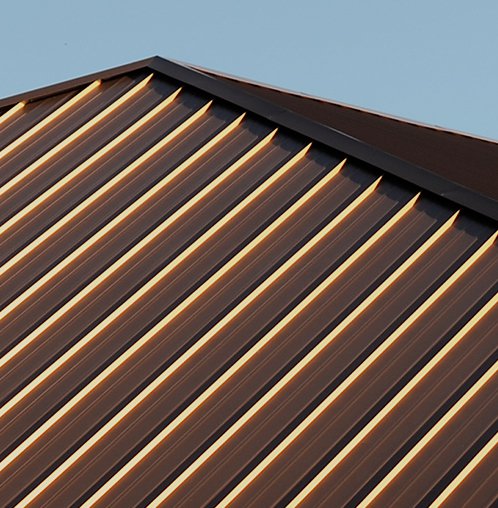
Copper or zinc: which suits a historic New Jersey house?
Copper fits most traditional work on older homes, especially bay windows, turrets, porches, dormers and cupolas, and it darkens from bright to brown and, over time, toward a green patina. Zinc gives a muted grey look and suits restorations and additions where the design calls for a quieter metal.
| Factor | Copper | Zinc |
|---|---|---|
| Look over time | Bright, then brown, then a green patina with long exposure | Supplied in grey tones, then weathers to its own even patina |
| Published lifespan | Copper Development Association: estimates of more than 100 years | VMZINC: a design life of 100 years |
| Common historic uses | Bay windows, turrets, porch roofs, dormers, cupolas, flashing | Restorations and additions that call for a grey metal |
| Seam styles | Standing seam, flat-lock, batten seam | Standing seam, flat-lock |
| National installed cost, labor by others included (HomeGuide) | About $1,300 to $3,000 per 100 square feet | About $1,000 to $2,000 per 100 square feet |
Read the lifespan figures carefully. The Copper Development Association says various estimates put a copper roof’s lifespan at more than 100 years, and VMZINC cites a 100-year design life for its zinc. Those are an industry estimate and a manufacturer’s design figure, not guarantees. Detailing, exposure and upkeep decide how long a specific roof lasts.
Mixed metals need a plan. Metal Sales, for example, excludes Galvalume panels exposed to runoff from copper or lead, or in contact with copper, from its panel warranty (Metal Sales Galvalume warranty). A copper bay roof that drains onto a painted steel porch roof needs a detail that keeps the water apart. Keep copper runoff off zinc and aluminum as well.
What does a copper or zinc roof cost?
Both cost more than painted steel. HomeGuide’s 2026 national guide estimates standing seam at $9 to $16 per square foot installed and premium metals such as copper and zinc at about $11 to $32 per square foot installed (HomeGuide).
These are national installed totals that include labor by others. They are not New Jersey prices and not our prices. Small historic roofs such as a bay, porch or turret often carry more detail work per square foot than a large plain slope, and your roofer prices that labor. For a materials price on the sheet metal parts, send the dimensions or your roofer’s cut list and ask us. Our metal roof panel prices guide explains what moves the number.
How do you get a copper or zinc roof approved and built?
Confirm the rules, file a clear application, then have your roofer build exactly what was approved.
- Call the zoning or historic preservation office and ask whether your property is in a local district and what a roof needs.
- Read the town’s design guidelines if it has them, such as Princeton’s, adopted September 22, 2026.
- Get a written scope and details from your roofer or architect showing metal, seam, trim and flashing.
- Submit photos, samples and product data, and attend the hearing if one is required.
- Order materials only after approval, and keep the approved drawings on site.
- Walk the finished roof against the approval before final payment.
When you hire a roofer for a house, New Jersey’s home improvement rules require a written contract for work over $500 that names the main materials and the start and finish dates. The same rules bar a contractor from starting before required permits are issued (state home improvement practices rules).
Historic roofs depend on small parts. Because we form flashing, trim and box gutter liners in our own shop, ridge caps, valley pans and gutter linings can be made to the approved details and your roofer’s dimensions instead of pulled from stock. We do not measure on site, so field dimensions come from your roofer. In copper or zinc, that fabrication is available on request; ask us. Painted steel parts and standing seam roof panels for the main house are part of our regular work, delivered in New Jersey or picked up at the shop.
Request a quote
Or call (732) 201-5224, Mo-Fr 07:00-17:00.
Historic district roofing questions
Does a National Register listing mean a new roof needs local approval?
Not by itself. For privately owned property, a listing on the New Jersey or National Register is generally honorific. Binding review comes from a local historic preservation ordinance, so check whether your town has designated your property or district.
Will a historic commission approve a copper roof?
There is no statewide answer. Approval depends on your town’s ordinance, its design guidelines and how closely the proposed roof fits the building. A clear application with photos, product data, seam details and a sample helps the review.
How long does a copper roof last?
The Copper Development Association says various estimates put a copper roof’s lifespan at more than 100 years. That is an industry estimate, not a guarantee; detailing, exposure and upkeep decide how long a specific roof lasts.
Is zinc a good choice for a historic home?
It can be, where the design and the reviewers call for a grey metal. VMZINC cites a design life of 100 years for its zinc roofing, which is a manufacturer figure rather than a guarantee. Zinc needs careful detailing, including keeping copper runoff off it.
Do I need a construction permit to replace the roof on a historic house?
For a detached one- or two-family home, replacing the roof covering is ordinary maintenance under New Jersey’s construction code and needs no construction permit. Local historic approval can still be required in a designated district, so check with the town first.
Does Princeton have new historic design guidelines?
Yes. Princeton’s Historic Preservation Commission adopted new Historic Design Guidelines on September 22, 2026. The town has 21 historic preservation overlay zoning districts, so owners there should read the guidelines before choosing roof materials.
Can you make copper or zinc parts for my roof?
Copper and zinc fabrication is available on request, so ask us. Send the approved details and the dimensions from your roofer or architect, and we reply with a quote or questions. Your roofer installs the parts.
Historic homes
Planning copper or zinc on an older house?
Send the approved details and the dimensions from your roofer or architect, and tell us the metal you have in mind. We reply with a written quote or questions. Copper and zinc fabrication is available on request, so ask us; painted steel trim and standing seam panels are made to order in our New Jersey shop.