
Liners, end caps, outlets and scuppers
Box Gutter Liners for New Jersey Buildings, Made to Size
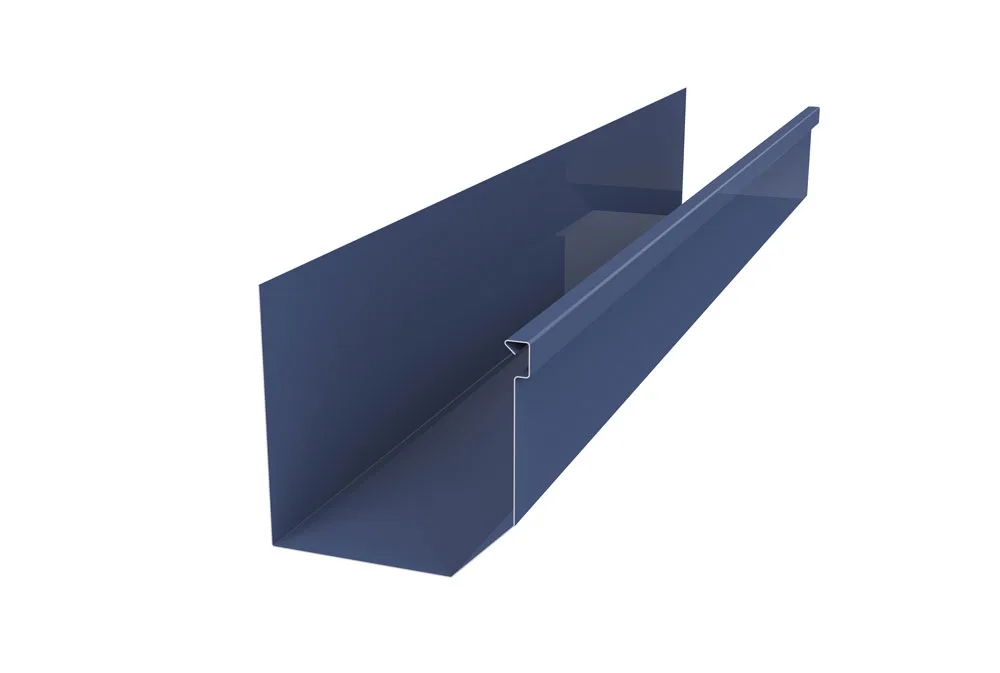
Box gutter liners in NJ are the formed metal troughs that keep water inside a built-in or commercial box gutter. We make liners and box gutter sections in our New Brunswick shop to the dimensions your contractor takes, in prefinished Galvalume steel, aluminum or 16 oz copper, with matching end caps, outlets and scuppers. Your contractor removes the failed liner and sets the new one. Owners can request a quote; builders and property managers can send plans.
- Owner's 26+ years in metal
- Delivery or shop pickup
- Free written quotes
What counts as a box gutter?
A box gutter is built into the structure instead of hung from the eave. On older houses it sits inside the cornice, hidden behind the trim. On commercial buildings it runs along a parapet or between roof sections.
Built-in gutters, also called Yankee or integral gutters, are common on older homes and commercial blocks. They look clean from the street, but they hold water right on top of the wall. When the liner fails, water goes into the cornice, the wall framing and the rooms below.
Signs of trouble include peeling paint or rot on the cornice, stains on top-floor ceilings and walls, ice building up at the eaves, and water spilling over the front edge in heavy rain. Gutters hung on the face of the eave are a different product; for those, see our 5- and 6-inch K-style gutters.
Repair, reline or replace?
If the wood behind the liner is sound, a new metal liner is usually the lasting fix. Spot repairs suit a small, isolated hole in a liner that is otherwise in good shape, and a full rebuild is needed when the gutter framing itself has rotted.
- Spot repair: patching or soldering a small hole or a failed seam. The rest of the old liner keeps aging.
- Membrane relining: a rubber or coated lining over the old metal. It changes the look and generally does not last as long as a well-made metal liner.
- New metal liner: the old liner comes out, the wood is repaired, and a new shop-formed liner goes in with proper slope, expansion joints and outlets.
- Rebuild: new framing and blocking where rot has reached the structure, followed by a new liner.
Our guide to box gutters on older New Jersey buildings walks through the repair, reline or replace decision in more detail.
How is a box gutter relined?
Your contractor takes the old liner out, fixes the wood, corrects the slope and sets a new liner we form to the gutter’s measured shape. The new liner runs up under the roofing and over the outer edge, so water cannot get behind it.
- Your contractor removes the old liner and any patches, then checks the blocking, cornice and rafter tails.
- They replace rotted wood and add tapered blocking where the gutter needs more slope toward its outlets.
- They measure the gutter profile at several points, since old gutters are rarely uniform, and send us widths, depths, run lengths and outlet locations.
- We form the liner sections, end caps, outlets and scuppers to those dimensions. Plan temporary protection for the open gutter while the liner is being made.
- The contractor lays a membrane under the liner and up the roof slope as good practice.
- They set the liner sections with soldered or sealed seams and expansion joints on long runs, run the back up under the roofing and fold the front over the cornice edge with a drip.
- They connect the outlets and downspouts and run water through the gutter to check the flow.
Copper, coated steel or aluminum liners?
Copper is the traditional, long-life liner and solders into watertight seams; we form liners in 16 oz copper. Prefinished Galvalume steel comes in the coil maker’s colors. Aluminum resists salt air but moves more with temperature and is joined with sealant or mechanical seams rather than solder.
| Item | 16 oz copper | Prefinished Galvalume steel | Aluminum (.032 or .040 inch) |
|---|---|---|---|
| Seams | Soldered | Sealed and riveted, or standing seams | Sealed or mechanical seams |
| Look | Bright at first, then darkens to brown and, over many years, green | Any stock color on the coil maker’s chart, in PVDF or SMP | Painted colors; does not rust |
| Life | Very long; the Copper Development Association cites estimates of more than 100 years for copper roofs | Long, with a PVDF finish and good slope | Long, and a good fit near salt water |
| Watch for | Runoff stains masonry and corrodes steel or aluminum below it | Salt-water warranty exclusions; keep copper runoff off it | High thermal movement, so expansion joints matter |
Historic liners were usually copper or tin-coated steel, so copper is the natural match on many older buildings. In a local historic district, a change in liner metal or in a gutter profile that shows from the street may need review under the town’s preservation ordinance before work starts. Owners who want the roof to match can also look at our copper and zinc sheet metal.
Do not pair a copper liner with steel or aluminum roofing or downspouts downstream of it. Metal Sales’ Galvalume warranty, for one, excludes areas that take runoff from copper.
Box gutter end caps, outlets and scuppers
We fabricate the end caps, outlet tubes, drop outlets, scuppers and conductor heads that finish a box gutter, made to the liner’s dimensions and in the liner’s metal, including 16 oz copper. Ordering them with the liner means every part fits the same profile and no mixed metals share the water path.
End caps
Each end cap is formed to the gutter’s cross-section, with a flange that laps inside the liner for a soldered or sealed joint. Send the profile at each end, since an old gutter often changes shape along its run.
Outlet tubes and drop outlets
A drop outlet is a flanged tube that passes through the gutter bottom into the downspout or leader. We form the flange to sit flat in the liner and the tube to the leader size you give us.
Scuppers and conductor heads
A scupper is an opening through a parapet or the outer wall of a gutter that lets water out. An overflow scupper sits below the liner’s back edge, so a clogged outlet spills outside instead of into the building. A conductor head is the collector box under a scupper that feeds the downspout.
How many outlets does a box gutter need?
Your designer or installer sizes outlets and scuppers to the roof area that drains to them and to heavy rainfall, rather than copying what was there before. Undersized or too few outlets are a common reason box gutters overflow into the cornice.
- More outlets shorten the distance water travels and lower the depth it reaches in the gutter.
- Tapered blocking under the liner slopes it toward each outlet, so water does not stand.
- Leaders should discharge away from the foundation.
Commercial box gutters often sit behind parapets and feed interior drains or exterior leaders. Your roofer and plumber coordinate the drain side, and we can form matching metal coping for the parapet above on the same order.
Why do box gutters fail in New Jersey winters?
Ice and standing water. Box gutters sit at the coldest edge of the roof, and any low spot in a liner holds water that freezes and works at the seams.
Ice dams make it worse by trapping meltwater against the liner’s back edge; our guide to ice dams and metal roofs in New Jersey explains how they form. Good slope, sound seams, expansion joints and a high back edge all help. Clear leaves from the outlets at least once a year and after big storms.
Our custom sheet metal page covers the related flashing work at the roof edge.
How do you order box gutter liners?
Send the gutter’s measured profile and run lengths, or plans, and we reply with a written quote within 24-48 hours. There is no minimum order, so a single end cap or outlet is quoted as readily as a full liner.
- Profile: bottom width, top width, depth, and the back and front edge heights, measured at several points along each run.
- Layout: run lengths, inside and outside corners, ends, and the location and leader size of each outlet and scupper.
- Metal: 16 oz copper, prefinished Galvalume steel or aluminum, plus the color for painted metal.
- How to send it: the quote form, the plan upload or email, or text us a photo of the sketch with the measurements on it.
The lead time is on your quote, and commercial jobs that call for shop drawings get them for approval first. We deliver within about a 5-hour drive of New Brunswick, across New Jersey, New York, Pennsylvania, Connecticut, Delaware and Maryland, with the delivery cost quoted with the order. You can also pick up at the shop during office hours, Monday–Friday 7 AM–5 PM.
Custom (non-stock) colors carry a minimum quantity. Have a lower written quote for the same parts? Send it with your request and we will match or beat it.
Box gutter questions
How long does a new box gutter liner last?
It depends on the metal, the slope and the upkeep. Copper is the long-life option, and coated steel and aluminum also last many years when the gutter drains well and the seams can move.
How do I get a price on a box gutter liner?
Send your contractor’s measurements of the gutter profile, the run lengths and the outlet locations, or plans. We reply with a written quote within 24-48 hours. Have a lower written quote for the same parts? Send it with your request and we will match or beat it.
Is copper worth it for a box gutter liner?
On historic buildings and homes you plan to keep, often yes: it solders into watertight seams and lasts a very long time, and we form liners in 16 oz copper. Prefinished steel costs less and suits buildings where a color match matters more.
Will a new liner change how the cornice looks?
Usually not. The liner sits inside the gutter, and the front edge folds over the cornice in a narrow band. In a historic district, send a sample or a dimensioned sketch of the original profile, and we can form the liner to match.
Can you make end caps and outlets for an existing liner?
Yes. Send the liner’s cross-section dimensions, its metal and the leader size, and we form end caps, drop outlets or scuppers to fit. Match the metal of the existing liner, so a copper liner gets copper parts.
What is the difference between a scupper and a conductor head?
A scupper is the opening that lets water out through a parapet or gutter wall. A conductor head is the collector box below it that catches that water and feeds the downspout. We fabricate both to your dimensions, in the same metal as the liner.
Do you work on commercial box gutters?
Yes. We fabricate metal box gutter sections and liners for commercial buildings, including gutters behind parapets, with outlets and overflow scuppers to the drawings. Property managers and builders can send drawings on our send plans page.
Do you reline box gutters yourselves?
No. We are a fabrication shop. We make box gutter liners and sections to the dimensions your contractor takes, and the relining work is done by your contractor. Field dimensions are the installer’s responsibility.
Request a quote
Tell us what you need: the product, the metal and finish, and your dimensions or cut list. Attach a photo, sketch or cut list if you have one. We reply with a written quote within 24-48 hours. Delivery within about five hours of our New Brunswick shop, or pickup.
Or text a photo or sketch with dimensions to (732) 236-8750
Prefer to talk now? Call (732) 201-5224, Monday–Friday 7 AM–5 PM. Text us a photo or sketch Fully insured
Box gutter liners made to size
Stained top-floor walls or a rotting cornice?
Have your contractor open up the gutter and send us its widths, depths and run lengths. We reply within 24-48 hours with a written quote for the liner sections, end caps, outlets and scuppers, delivered or ready for pickup. Builders and property managers can send plans.