
Compare metal roof systems
Types of Metal Roofing and the Panels We Make for Your Roofer
The main types of metal roofing are standing seam panels, exposed-fastener rib and corrugated panels, metal shingles and shakes, and natural copper and zinc. This guide explains how each type looks, what slope it needs and where it fits, so you can choose with your roofer. Architectural Metal Panels is a fabrication shop in New Brunswick, NJ: we make the panels and trim, and your roofer installs them.
- Owner's 26+ years in metal
- Delivery or shop pickup
- Free written quotes
Which type of metal roof suits your building?
For most houses, standing seam. For barns, sheds and outbuildings, exposed-fastener panels. For a slate or shake look, metal shingles. For historic details and the longest service life, copper or zinc.
| Type | Fasteners | Typical lowest slope | Common uses |
|---|---|---|---|
| Standing seam, snap-lock | Hidden under the seam | 3:12 for our 1.75-inch snap-lock | Houses, garages, additions |
| Standing seam, mechanical lock | Hidden; the seam is folded closed on the roof | 1/2:12 over solid deck for our 1.5-inch mechanical lock | Low slopes, long runs, snowy sites, commercial roofs |
| Exposed-fastener rib and corrugated | Screws through the panel face | 3:12, or 1/2:12 with applied lap sealant | Barns, sheds, pole buildings, garages |
| Metal shingles and shakes | Hidden in the interlocks | 3:12 | Traditional-looking homes |
| Copper and zinc standing seam | Hidden clips and cleats | 1/2:12 over solid deck for our 1.5-inch mechanical lock | Bays, porches, turrets, full roofs |
The sections below explain each type in plain terms, then how your roofer orders the panels and trim from our shop.
What is standing seam metal roofing?
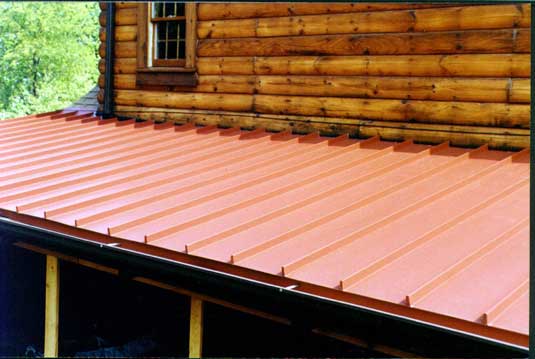
Standing seam is a roof of long, flat panels joined at raised seams, with the clips hidden under the seams. Because no screws go through the face of the panel, it is a common choice for houses.
The panels usually run in one piece from eave to ridge, cut to the lengths on your roofer’s cut list. We fabricate standing seam in Galvalume steel, aluminum, copper and zinc, with seam heights of 1, 1.5, 1.75 and 2 inches. Our standing seam roof panels page lists the widths, gauges and finishes.
Snap-lock standing seam
Snap-lock panels click together along the seam, so they go on without a seaming tool. Our 1.75-inch snap-lock comes in panel widths of 12 to 18 inches, in 26, 24 or 22 gauge steel or .032- or .040-inch aluminum. It typically needs at least a 3:12 slope.
Mechanical lock standing seam
Mechanical lock panels are folded closed on the roof with a seaming tool, to a 90 or 180 degree seam. Our 1.5-inch mechanical lock runs 12 to 20 inches wide in 26 or 24 gauge steel, .032-inch aluminum, 16 oz copper or 0.7 and 0.8 mm zinc. It typically works down to a 1/2:12 slope over solid deck.
The seam type matters in snow. Sheffield Metals notes that snap-lock seams are more prone to disengaging as built-up snow and ice move, and suggests mechanically seamed panels in snowy regions. Our guide to snap-lock vs mechanical lock standing seam walks through the choice.
What are exposed-fastener and corrugated metal roof panels?
They are ribbed or corrugated sheets fastened through the face with gasketed screws. They go on quickly, which is why they are common on barns, sheds, pole buildings, detached garages and lean-tos.
The trade-off is upkeep. Each exposed screw has a washer that ages in the sun, and screws can loosen as the metal expands and contracts. On a heated house, many roofers prefer standing seam for that reason. The model residential code sets the lowest slope for lapped panels at 3:12, or 1/2:12 with applied lap sealant.
Our exposed-fastener profiles include:
- AMP PBR panels: 1-1/4-inch deep ribs, 36-inch coverage and a purlin-bearing leg, for roofs and walls.
- The AMP 7.2 Rib: 1-1/2-inch ribs at 7.2 inches on center and 36-inch coverage, for walls or roofs.
- Corrugated panels in 2.67 x 1/2 and 2.67 x 7/8 profiles, compared on our corrugated metal panels page.
- AG panels for farm buildings, on our barn and pole-building panels page.
What are metal shingles and shakes?
They are smaller interlocking metal pieces pressed and painted to look like slate, cedar shake, clay tile or asphalt shingles. They suit owners who want metal that does not read as panels from the street, and the model residential code sets a 3:12 minimum slope for them.
Metal shingle and shake systems are manufactured products with their own matching trim, sold through their makers’ own channels. Where a chimney or wall on such a roof needs a custom-bent piece, your roofer can send us the dimensions for custom metal flashing.
What about copper and zinc roofs?
Copper and zinc are natural metals with no paint; they weather to a patina over the years. They cost the most of the metal roof types and, by published estimates, last the longest.
The Copper Development Association says various estimates put a copper roof’s life at more than a century, and VMZINC cites a 100-year design life for its zinc roofing. Those are estimates, not guarantees.
We fabricate copper, mostly 16 oz, and zinc in 0.7 and 0.8 mm, including 1.5-inch mechanical lock panels and the trim and flashing that go with them. Both are common on the bay windows, porches and turrets of older homes. See copper and zinc sheet metal and our guide to copper and zinc roofs in historic districts.
Which type works near the shore or in heavy snow?
At the shore, the base metal matters more than the panel type. In heavy snow, the seam type and snow guards matter most.
Near salt water, steel warranties can exclude the site, so aluminum panels are the common alternative; our guide to metal roofing near the Jersey Shore explains the distances. In heavy snow, many roofers choose mechanical lock seams and add snow guards above doors and walkways; see snow guards for metal roofs. Ice dams start with attic heat under any roof type, as our guide to ice dams and metal roofs explains.
How does your roofer order metal roof panels from us?
Your roofer measures the roof, writes a cut list and sends it to us. Field dimensions are the installer’s responsibility, so the lengths on the cut list are the lengths we make.
- Send the cut list, a sketch with measurements or plans through the quote form, by email to info@architecturalmetalpanels.net, or text a photo to (732) 236-8750.
- We reply with a written quote within 24-48 hours, or with questions.
- Standing seam panels and trim are typically ready in 1-2 days, depending on color and gauge.
- We deliver within about a 5-hour drive of our New Brunswick shop, or you pick up at the shop during office hours, Monday–Friday 7 AM–5 PM.
There is no minimum order. Have a lower written quote for the same parts? Send it with your request and we will match or beat it. Our guide on how to send a cut list for metal roof panels shows what to include, and what drives the cost of metal roof panels explains the price side. Weighing metal against another shingle roof? Read the benefits of metal roofing and why asphalt roofs fail.
Request a quote
Tell us what you need: the product, the metal and finish, and your dimensions or cut list. Attach a photo, sketch or cut list if you have one. We reply with a written quote within 24-48 hours. Delivery within about five hours of our New Brunswick shop, or pickup.
Or text a photo or sketch with dimensions to (732) 236-8750
Prefer to talk now? Call (732) 201-5224, Monday–Friday 7 AM–5 PM. Text us a photo or sketch Fully insured
Questions about types of metal roofing
What are the main types of metal roofing?
Standing seam panels (snap-lock and mechanical lock), exposed-fastener rib and corrugated panels, metal shingles and shakes, and natural copper and zinc. Each has its own look, minimum slope and best use.
What is the difference between snap-lock and mechanical lock standing seam?
Snap-lock panels click together; mechanical lock panels are folded closed on the roof with a seaming tool. Our 1.75-inch snap-lock typically needs a 3:12 slope, while our 1.5-inch mechanical lock typically works down to 1/2:12 over solid deck.
Which type of metal roof lasts longest?
By published estimates, copper and zinc: more than a century for copper per the Copper Development Association, and a 100-year design life for zinc per VMZINC. Among painted metals, standing seam with hidden fasteners needs the least upkeep.
Can I use exposed-fastener panels on my house?
You can, but many roofers prefer standing seam on a heated home. Exposed screws need periodic checks, and lapped joints are less forgiving of ice. Exposed-fastener panels are a sound, economical choice for barns, sheds and garages.
Are metal shingles as good as standing seam?
They do a different job. Standing seam has fewer joints and works on lower slopes, while metal shingles and shakes need at least 3:12 under the model code and suit owners who want a traditional texture.
Who installs the panels you make?
Your roofer. We are a fabrication shop: we make the panels and trim to your roofer’s cut list, and the roofer installs them. Homeowners can send us the cut list themselves, or the roofer can order.
Choosing a system
Not sure which panel your roof needs?
Send your roofer’s cut list and the roof pitch, and tell us which types you are weighing. We reply within 24-48 hours with a written quote, or with questions, for the panels and trim that fit.