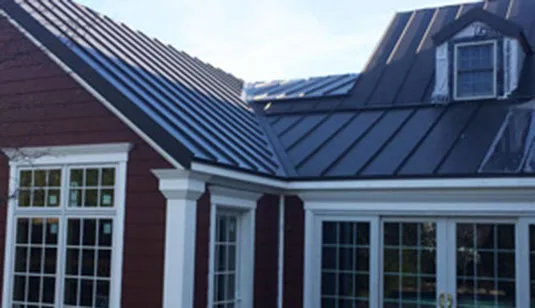
When you compare 5-inch vs 6-inch gutters, the real question is how much water reaches each gutter run in the hardest rain. A 5-inch K-style gutter carries the water from most ordinary house roofs. A 6-inch gutter earns its place where a large or steep roof plane, a valley or a long run sends more water to one gutter than a 5-inch can move to its downspouts.
This guide is for installers, contractors and homeowners who have their own installer. Architectural Metal Panels roll-forms 5-inch and 6-inch K-style gutters to length in our New Brunswick shop, along with end caps, miters and downspout parts. Your installer hangs them. Still choosing a metal? Read our guide to gutter coil in aluminum, steel or copper.
What is the difference between 5-inch and 6-inch K-style gutters?
The number is the width across the top of the gutter. A 6-inch K-style is both wider and deeper than a 5-inch, so it holds and moves noticeably more water, and it takes a larger outlet and downspout.
K-style describes the shape: a flat back that sits against the fascia, a flat bottom and a front face shaped like crown molding. Because the cross-section grows in width and depth at the same time, the gain in capacity is larger than the one inch on the label suggests.
The bigger gutter also has a taller face, so it reads heavier on the house. On a small one-story roof with a narrow fascia board, 6-inch can look out of scale. On a tall two-story wall or a large roof it usually looks right. The fascia board must also be tall enough to back the gutter, so check it before you choose.
How do installers size gutters for a roof?
They start with the roof area that drains into each gutter run, then adjust for roof pitch and the rainfall intensity used for the area. The result sets the gutter size and how many downspouts each run needs.
What goes into the sizing?
- Drainage area. Only the roof planes above a run send water to it. A large house can still have small runs, and a small house can have one big one.
- Roof pitch. Steep roofs catch more wind-driven rain and deliver water to the eave faster, so sizing methods add an allowance for pitch.
- Rainfall intensity. Gutters are sized for the heaviest short bursts of rain, measured in inches per hour, not for yearly totals. A summer cloudburst sets the size, not a steady drizzle.
- Downspouts. Their number, size and spacing decide how fast the gutter empties.
- Valleys and upper roofs. A valley gathers water from two planes into one spot, and an upper roof that drains onto a lower one adds its water to the lower gutter.
Published sizing tables combine these factors. On a large or unusual roof, ask the person sizing the gutters to show the numbers for each run. That is the only fair way to compare two installers’ plans.
When does a 6-inch gutter make sense?
Choose 6-inch for any run that collects more water than usual. Typical cases are large or steep roof planes, the eave below a valley, long runs with few places for a downspout, and lower roofs that take water from above.
- Large roof planes. A deep plane, eave to ridge, sends far more water to one eave than a short one.
- Steep pitches. Fast water from a steep roof is more likely to shoot over the front edge of a narrow gutter in a downpour.
- Valleys. Where a valley meets the eave, two planes empty into one point. That corner is a common overflow spot for 5-inch gutters.
- Long runs. If the walls allow downspouts only at the ends, each section of gutter carries water a long way. A larger gutter adds capacity without extra downspouts.
- Commercial, farm and garage roofs. Wide roofs on shops, barns and garages often drain a large area to a single eave.
A metal roof is a special case. Smooth panels shed water quickly, and snow can slide off in heavy slabs that land on the gutter. Size the gutter for the water, and plan snow guards above it; our guide to snow guards for metal roofs covers where they go.
When is 5-inch enough?
On most single-family roofs with moderate pitch and enough downspouts, 5-inch K-style does the job. It uses less coil per foot and suits smaller fascia boards. If one run of an existing 5-inch system overflows at a single corner, an extra downspout is often a simpler fix than a bigger gutter. Many houses mix the two, with 6-inch only on the runs that need it.
Which downspout size goes with each gutter?
Downspouts come in standard rectangular sizes such as 2 x 3 inch and 3 x 4 inch. The larger size is the usual partner for 6-inch gutters and the smaller one for 5-inch, but the count and placement matter as much as the size.
A downspout can only drain what reaches its outlet. On a long run, a downspout at each end, with the gutter sloped toward both, cuts the distance water has to travel. Where a downspout empties onto a lower roof, the gutter below has to carry that water too. At the ground, each downspout needs a splash block, an extension or a drain line that moves water away from the foundation.
Tell us the downspout size and the number of outlets on each run, and the downspout parts go on the same quote as the gutters.
Will a bigger gutter stop ice dams?
No. Gutter size does not prevent ice dams. According to University of Minnesota Extension, the cause is heat loss: warmth from the house melts snow on the upper roof, and the meltwater freezes again when it reaches the cold eave. The fix starts in the attic, as our guide to ice dams and metal roofs explains. A gutter packed with ice is also heavy, so sound hangers matter more than extra size.
What should you send when you order K-style gutters?
Send the gutter size, the metal and color, and a list of runs with their lengths, plus corners, end caps and downspouts. We roll-form each run to the length you send, so the gutter has no seams along the run.
- Gutter size: 5-inch or 6-inch K-style, run by run if you mix them
- Metal and color: aluminum, steel or copper coil, and the color name
- Each run: its length, and which ends get end caps
- Corners: inside or outside miters, and where they go
- Downspouts: size, number of outlets per run and where each outlet sits
- Job address for delivery, or pickup at the shop
Field dimensions are your installer’s responsibility. We fabricate to the numbers you send and do not measure on site. Use the quote form, email info@architecturalmetalpanels.net, or text a photo of the sketch to (732) 236-8750. You get a written quote within 24-48 hours, and there is no minimum order.
The lead time is on your quote. Orders are delivered within about a 5-hour drive of the shop, or picked up during office hours, Monday–Friday 7 AM–5 PM. For very long runs, ask about delivery when you order. Gutters are one part of our custom sheet metal work, so flashing and trim can go on the same order.
5-inch and 6-inch gutter questions
Is a 6-inch gutter worth it on an average house?
Often it is not needed. If the roof planes are moderate in size and pitch and each run has enough downspouts, 5-inch K-style gutters usually carry the water. Use 6-inch on the runs below valleys, large planes or steep slopes.
Can 5-inch and 6-inch gutters be mixed on one house?
Yes. Installers often put 6-inch only on the runs that need it, such as the eave below a valley or a large rear roof, and 5-inch elsewhere. The two sizes have different face heights, so keep each elevation consistent if looks matter.
What size downspout goes with a 6-inch gutter?
A 3 x 4 inch downspout is the usual partner for 6-inch K-style gutters, and 2 x 3 inch for 5-inch. How many downspouts each run has, and where they sit, matters as much as their size.
Do bigger gutters prevent ice dams?
No. Ice dams form when heat leaking from the house melts roof snow that refreezes at the cold eave. Air sealing, insulation and ventilation address ice dams; gutter size does not.
Can you make gutters to the lengths my installer measured?
Yes. We roll-form 5-inch and 6-inch K-style gutters to the run lengths your installer sends, from aluminum, steel or copper coil, with end caps, miters and downspout parts. Your installer hangs them.
K-style gutters
Ordering 5-inch or 6-inch gutters?
Send the gutter size, metal, color and run lengths your installer measured, with the corners and downspouts. We reply with a written quote within 24-48 hours for gutters roll-formed to length in our New Jersey shop.