
Metal roof flashing is the formed sheet metal that seals the joints a roof covering cannot: where the roof meets a wall, a chimney, a valley, a pipe or its own edge. Most roof leaks start at one of those joints, not in the open field of the roof. Find the joint that leaks, and you know which piece of flashing fixes it.
Architectural Metal Panels is a metal fabrication shop in New Brunswick, NJ. We bend metal flashing and trim to the dimensions roofers and owners send us, and your roofer sets it. This guide walks the roof from top to bottom: each common leak spot, what usually fails there and the flashing that fixes it.
What does metal roof flashing do?
Flashing turns water away from a joint and hands it back to the roof surface. It works with laps and gravity, not glue. Each piece tucks under the material above it and over the material below it, so water always lands on the next layer down.
Good flashing also lets parts move. A roof deck, a brick chimney and a framed wall expand, shrink and settle at different rates. Two-piece details, such as base flashing covered by a separate counter-flashing, let each side move without tearing the seal. That is why a joint held together only by caulk rarely stays dry.
Where do roof leaks usually start?
Most leaks start at seven spots: chimneys, roof-to-wall joints, valleys, pipes and curbs, eaves and rakes, low-slope roof edges, and any joint where sealant took the place of metal. The table pairs each spot with its usual failure and the fix.
| Leak spot | What usually fails | The flashing that fixes it |
|---|---|---|
| Chimney | Counter-flashing caulked to the brick face; no cricket | Step flashing, counter-flashing set in a mortar joint, and a cricket |
| Roof along a sidewall | No kick-out at the bottom; reused step flashing | New step flashing and a kick-out |
| Roof meeting a wall above | Apron lapped over the wall barrier instead of under it | Headwall (apron) flashing tucked under the wall barrier |
| Valley | Narrow metal, nails in the channel, debris | Wider valley metal, fastened only at its edges |
| Pipes, vents and skylights | Cracked rubber boots; nothing to divert water above a curb | New pipe flashing; curb flashing with a diverter or cricket |
| Eaves and rakes | Ice backing up; raw edges; no drip | Drip edge, eave and rake trim with hemmed edges |
| Low-slope edges and parapets | Loose edge metal; open coping joints | Edge metal or gravel stop, coping and counter-flashing |
Why does a chimney leak, and which flashing fixes it?
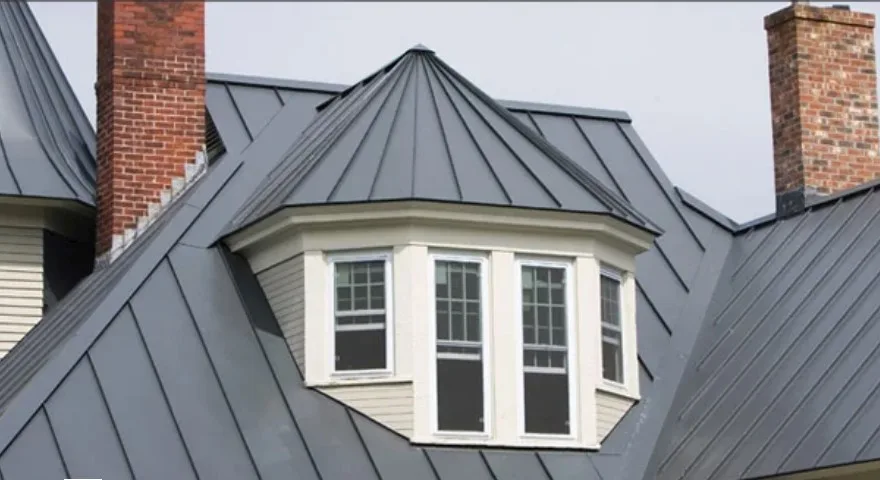
Chimneys leak most often because the counter-flashing was sealed to the face of the brick instead of being set into a mortar joint. Once that caulk line cracks, water runs down behind the step flashing and into the attic.
A chimney packs every hard detail into one spot: four sides, masonry that moves differently from the framing, and a wide upslope face that collects water. A sound repair has three parts. Step flashing weaves into the roofing up each side. Counter-flashing is set into a cut mortar joint, called a reglet, and laps over the step flashing. On a wide chimney, a cricket on the upslope side splits the water so it cannot pond.
Not every chimney leak is a flashing leak. Water also gets in through a cracked crown, porous brick or an open flue. If the flashing looks sound, have the roofer check the top of the chimney too. A custom chimney cap with drip edges keeps rain off the crown and out of the flue.
Why does water get in where a roof meets a wall?
Roof-to-wall leaks usually trace to a missing kick-out, or to step flashing that was reused or lapped the wrong way. The runoff from a whole roof edge travels down that joint, so one small mistake there does a lot of damage.
- Sidewalls. Where a slope runs along a wall, short L-shaped step flashings weave into each course of roofing, each one lapping over the one below.
- The bottom of a sidewall. A kick-out turns the water out into the gutter. Without one, it pours behind the siding at the lowest corner, and the rot that follows often gets blamed on a window.
- Headwalls. Where the top of a slope meets a wall, one continuous apron flashing drops water onto the roof. Its top leg belongs under the wall’s water barrier, not over it.
A kick-out only works if a gutter is there to take the water. Our 5-inch and 6-inch K-style gutters are roll-formed to length in the shop for your installer to hang.
Why do roof valleys leak?
Valleys leak when the metal is too narrow, when fasteners go through the water channel or when debris pushes water sideways under the roofing. A valley carries the runoff of two roof planes at once, plus leaves and ice.
The fix is valley metal wide enough for the roof area above it, fastened only at its outer edges with cleats or clips. A center rib helps stop water from one slope rushing across and up under the other. On a standing seam roof, the panels turn down into a formed valley pan, and pipes and skylights should stay well clear of it.
Why do pipes, vents and skylights leak?
Rubber pipe boots harden and crack in the sun long before the roof around them wears out. That makes them one of the most common leak spots on any roof, and one of the easiest to fix.
Larger openings need more planning. A skylight curb or rooftop unit acts as a dam across the slope, so water and ice pile up against its upslope side. A diverter or small cricket above the curb steers water around it. On metal roofs, a pipe flashing should sit in the flat of a single panel, clear of the seams, so it never straddles a joint that has to move.
Why do eaves and rakes leak?
Eaves leak when ice dams back water up under the edge metal and the first courses of roofing. Rakes leak when wind drives rain under trim that has no hem or no drip.
Heat escaping from the house causes ice dams, so the attic matters as much as the metal; our guide to ice dams and metal roofs explains why. On the metal side, the eave needs a drip edge that throws water clear of the fascia. Rake trim should hook over a cleat, with hemmed edges so no raw cut faces the weather. We make drip edge, eave and rake pieces as custom trim and brake metal in the roof color.
What about flat and low-slope roof edges?
Low-slope roofs lean on edge metal even more than steep roofs do, because water moves slowly and sometimes stands. Loose edge metal and open coping joints are the usual entry points.
At an open roof edge, the membrane ends under ES-1 edge metal and gravel stop held by a continuous cleat. At a parapet, metal coping caps the wall, and counter-flashing covers the membrane where it turns up the wall. Many older buildings add built-in box gutters behind the parapet, with weak points of their own. Our guide to parapet leaks shows how to trace water that enters a wall top.
How does flashing change on a standing seam roof?
The same lapping rules apply, with one addition: metal panels grow and shrink with temperature, so the flashing has to let them slide. Endwall and sidewall flashings fasten to the wall and to cleats rather than rigidly through the panel.
Closures at the ridge and headwalls block wind-driven rain and insects. Penetrations are best grouped or moved before the panels are laid out. Your roofer can send us the layout and each curb size, and we form the diverters and trim to match the standing seam roof panels.
Mixed metals need a plan too. Metal Sales’ AZ55 Galvalume warranty excludes areas that get runoff from copper or lead flashings, so copper should never drain onto a Galvalume roof. Our page on copper and zinc sheet metal covers those metals.
How can you spot a flashing problem early?
Most flashing leaks give warning before they reach a ceiling. Look from the ground or a window with binoculars, and leave walking the roof to someone with fall protection.
- Stains on a ceiling or wall near a chimney, skylight or dormer
- Rot, peeling paint or soft siding below a roof-to-wall joint
- Tar or caulk smeared over metal
- Counter-flashing pulled away from the brick, or missing mortar above it
- Rust streaks or lifted edges on flashing and trim
- Leaks that appear only in wind-driven rain or during a thaw
Should flashing be repaired or replaced?
Repair it when one piece has failed and the metal around it is sound. Replace it when the metal is corroded or thin, when the original detail was wrong, or whenever the roof itself is replaced.
Sealant is not a repair. Tar or caulk over a joint can stop a drip for a season, but it hides the defect, traps water against wood and metal, and has to be scraped off before the real fix. A backward lap or a missing kick-out cannot be fixed in place; the piece has to come out and go back in the right order. Reusing old flashing under a new roof is a false saving, because the new roof is only as tight as its oldest piece. Once your roofer has the dimensions, we form replacement pieces on a 10-foot CNC folder in Galvalume steel, aluminum, copper (mostly 16 oz) or zinc, with no minimum order.
Metal roof flashing questions
How long does metal roof flashing last?
It depends on the metal and the detail. Prefinished steel or copper flashing that is formed and lapped correctly can last as long as the roof around it, and copper often longer. Rubber pipe boots and sealant joints wear out much sooner, so have them checked every few years.
Why does my chimney leak only in heavy, windy rain?
Wind drives water sideways and upward, past details that shed ordinary rain. The usual causes are counter-flashing caulked to the brick face instead of set into a mortar joint, a missing cricket, a cracked crown or porous brick above the flashing.
Do I need ice and water shield under flashing in New Jersey?
The state construction code requires an ice barrier only in Sussex County, according to DCA Bulletin 07-3. Elsewhere it is not a code requirement, but it is good practice at eaves, valleys and around chimneys, so ask your roofer to include it.
Can a shop make flashing to match a piece on my roof?
Yes. Send a sketch of the profile with every leg length and bend, plus the metal, color, lengths and counts. We bend new pieces to those numbers. Your roofer takes the measurements, because field dimensions are the installer’s responsibility.
How fast can flashing and trim be made?
Coping and trim, flashing included, typically take 1-2 days to fabricate, depending on color and gauge. We send a written quote within 24-48 hours of receiving your dimensions, and the order is delivered or picked up at the shop.
Flashing made to your dimensions
Need flashing for a chimney, wall or valley?
Send a sketch with your roofer’s dimensions, the metal, the color and the counts, or text us a photo of the sketch. We reply with a written quote within 24-48 hours. Orders are delivered within about a 5-hour drive of our New Brunswick shop, or picked up during office hours, Monday–Friday 7 AM–5 PM.