Metal wall panel installation decides whether a wall stays flat, dry and quiet for decades or starts to wave, leak and tick within a few seasons. The panel is rarely the problem. That makes the installer the most important choice you make after the panel itself.
Architectural Metal Panels is a metal fabrication shop in New Brunswick, NJ. We make metal wall panels, trim and flashing to the dimensions your installer sends, and we do not install them. This guide is written from the shop side: why a professional installer matters, how to choose one, and how you, your installer and the shop work together on one order.
Why do metal wall panels need a professional installer?
Most wall panel failures start behind the panel and show up a season later. Each one comes from an installation decision, not a panel defect.
- Wavy walls from girts or furring that are out of plane. A metal panel copies whatever is behind it.
- Hidden water damage when nothing drains the wall behind the panels.
- Leaking or loose fasteners from the wrong screw, spacing or torque.
- Leaks at openings where trim was lapped backward or held on with caulk.
- Buckling and popping when panels are pinned so they cannot move with temperature.
- Oil canning, the visible waviness in flat areas, made worse by an uneven substrate and overdriven screws.
A professional prevents these by surveying the wall first and shimming the framing into one flat plane. They build a drained water path, follow the panel’s fastener pattern and lap every piece of trim in the right order.
Who does what on a metal wall panel job?
Three parties share the work: you, your installer and the fabricator. Knowing who owns each step closes the gaps where most problems start.
| Task | Who does it |
|---|---|
| Choose the profile, color and finish | Owner or architect, with the installer |
| Measure the walls and openings | Installer |
| Build the cut list and trim list | Installer |
| Written quote for panels and trim | Fabricator, within 24-48 hours |
| Shop drawings for approval | Fabricator, on architectural and commercial jobs |
| Fabricate panels, trim and flashing | Fabricator |
| Delivery or pickup | Fabricator delivers, or you pick up at the shop |
| Framing, barrier, panels and trim on the wall | Installer |
| Installation warranty | Installer |
| Finish warranty | Coil maker |
Field dimensions are the installer’s responsibility, because we fabricate to the numbers we receive and do not measure on site. Finish warranties come from the coil maker; our warranties page explains who covers what.
What should you ask before hiring a metal wall panel installer?
Ask questions only an experienced installer can answer, and get the answers in writing.
- Have you installed this profile before? Concealed-fastener and exposed-fastener panels go up differently, and so do composite trays.
- Which installation guide will you follow? It sets the fastener schedule: screw type, length, spacing and the tighter pattern at corners and edges.
- How will you get the wall flat? On older brick and settled framing, expect a plan to survey and shim the sub-girts.
- How will water drain behind the panels? Listen for a lapped water-resistive barrier, flashed openings, base flashing and an air gap or drainage mat.
- How do you handle trim at windows and corners? Every upper piece should lap over the piece below, and sealant should back up the metal, never replace it.
- Who takes the measurements and builds the cut list? The answer should be the installer.
- What will the written contract cover? The panel by name, gauge, color, the trim scope, start and finish dates, the total price and any installation warranty.
Registration for home projects
In New Jersey, a contractor business may not offer or perform home improvements on residential property unless it is registered with the Division of Consumer Affairs (P.L.2023, c.237). Registration also requires general liability insurance, workers’ compensation unless the business is exempt, and a bond or other security. The registration number belongs on the installer’s contracts and advertising. It does not cover purely commercial work.
How do you choose the panel with your installer?
Pick the profile for the wall, not just the look. Flat, concealed-fastener faces show every wave in the framing, while ribbed and corrugated faces hide more.
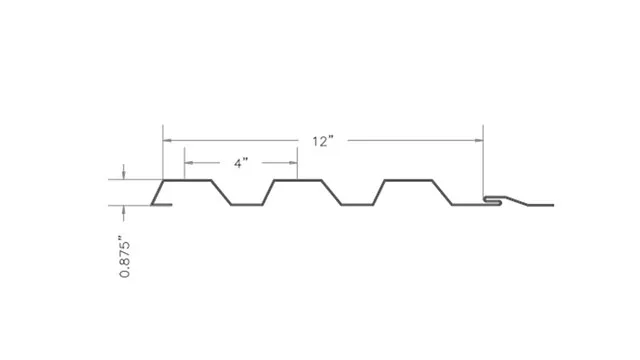
- AMP Wave 16-4: concealed fastener, 16-inch coverage, 7/8 inch deep, four ribs on a 4-inch module
- AMP Wave 12-3: concealed fastener, 12-inch coverage, 7/8 inch deep, three ribs
- AMP 7.2 Rib: exposed fastener, 1-1/2 inch ribs at 7.2 inches on center, 36-inch coverage
- AMP PBR panel: exposed fastener, 1-1/4 inch deep, 36-inch coverage
- Corrugated metal wall panels: 2.67-inch pitch in 1/2 inch and 7/8 inch depths
- Seamless metal siding: woodgrain-embossed steel or aluminum, roll-formed to the full length of the wall
- Aluminum composite panels: routed and folded trays for storefronts and entrances
On an old wall that cannot be made flat, a ribbed or wave profile is the forgiving choice, and lower-gloss finishes show less waviness. For composite panels, our guide to wet-seal and dry-joint ACM covers the joint choice.
What does the installer need to send for a quote?
A cut list and a trim list, or a set of plans. The more complete the list, the faster and firmer the quote.
- Profile, gauge, metal and color
- Panel direction, horizontal or vertical
- Each panel length and how many of each
- Every trim piece with a sketch of its profile: base, head, jamb, sill, corners and the top of the wall
- Flashings, and metal coping if the wall ends at a parapet
We reply with a written quote within 24-48 hours, and there is no minimum order. Custom, non-stock colors carry a minimum quantity. Trim and coping typically take 1-2 days to fabricate, depending on color and gauge, and the panel lead time is on your quote. Trim comes from our custom trim and brake metal shop in the panel color, with metal flashing on the same order.
How much do metal wall panels move with temperature?
Enough to tear sealant and shear screws if nobody plans for it. A long panel grows on a sunny afternoon and shrinks overnight, and aluminum moves roughly twice as much as steel.
Good installers allow for it with slotted holes and floating clips, sensible panel lengths, expansion joints in long trim runs and properly sized sealant joints. Panel lengths are fixed when we cut the order, so settle them with your installer before the cut list comes to us. Loud popping, elongated screw holes and buckled panels usually mean movement was ignored.
What should the installer check when the order arrives?
Check the delivery against the cut list before work starts, then store it so it stays dry and straight.
- Count panels and trim against the cut list, and measure a few lengths of each
- Confirm the color and the finish side before any panel goes on the wall
- Store bundles off the ground, sloped and covered so water drains away, since trapped moisture can stain the metal
- Carry long panels on edge so they do not twist or kink
Who covers what if a wall has a problem?
Coating failures, such as peeling or excessive fading, fall under the finish warranty from the coil maker. Problems with how the wall was put together go to your installer, under the installation warranty in their contract.
Finish warranties carry conditions an untrained installer may never read. The Metal Sales AZ55 Galvalume warranty, for example, excludes bends tighter than its 2T and 4T limits and damage from contact with green or wet lumber. That is one more reason to hire someone who reads the paperwork before the first screw.
Can you install metal wall panels yourself?
For a garden shed or a small accent wall, a handy owner with exposed-fastener panels and the maker’s guide can get a fair result. On an occupied home, a storefront or any wall with openings, the risk climbs fast. The hard part is not cutting and screwing; it is reading the wall, building the water path and getting every lap in order.
If you do the work yourself, you are the installer: we make the parts to your dimensions, and the measurements are yours. Re-siding a one- or two-family home is ordinary maintenance under the state construction code, while larger re-clads on other buildings generally need a permit.
Metal wall panel installation questions
Can metal wall panels go over existing brick or block?
Usually, yes. The installer anchors girts or hat channels to the masonry, shims them into one flat plane and fastens the panels to that framing. Any cracking or moisture problem in the old wall should be fixed first, because the panels will hide it.
Do metal wall panels need an air gap behind them?
In most cases a drainage space helps. It lets water that gets past the panels drain out and lets the wall dry. Rainscreen systems build the gap in on purpose; simpler walls rely on a lapped water-resistive barrier and base flashing.
Is oil canning a defect?
Not always. Some waviness is inherent to flat metal, and coil makers treat it differently, so read the finish literature before you order. A flat substrate, careful fastening, ribbed or wave profiles and lower-gloss finishes all reduce how much shows.
Who measures the wall for a metal panel order?
Your installer. They measure the walls and openings, build the cut list and trim list, and send them to us. We fabricate to those dimensions and do not measure on site.
How fast can wall panels and trim be made?
Trim and coping typically take 1-2 days, depending on color and gauge, and ACM panels 2-8 weeks, depending on color. The lead time for other wall panels is on your quote, which we send within 24-48 hours of receiving the cut list.
Metal wall panels made to your installer’s list
Send your installer’s cut list for a quote
Send the profile, gauge, color, panel lengths and trim list your installer measured, or a set of plans. We reply with a written quote within 24-48 hours. Orders are delivered within about a 5-hour drive of our New Brunswick shop, or picked up during office hours, Monday–Friday 7 AM–5 PM.
Have a lower written quote for the same parts? Send it with your request and we will match or beat it.